Healthcare Tools
GPT Workbench includes 23 specialized healthcare and biomedical tools that provide direct access to major scientific databases, drug registries, genomic resources, and clinical research platforms. These tools enable researchers, clinicians, and life sciences professionals to query authoritative data sources directly from within a conversation.
All healthcare tools use the Model Context Protocol (MCP) and are categorized under the medical category in the tool selector. Most require no API keys and connect to publicly available scientific databases.
Overview
The healthcare tool suite covers six domains:
| Domain | Tools | Primary Use |
|---|---|---|
| Genomics and Genetics | 6 | Variant analysis, protein structures, population genetics, polygenic scores |
| Pharmacology and Drug Information | 4 | Drug databases, pharmacogenomics, chemical compounds |
| Clinical Research | 3 | Clinical trials, data capture, family pedigrees |
| Biomedical Literature | 6 | PubMed, preprint servers, reference management |
| Bioinformatics and Data | 3 | Gene-drug-disease relationships, multi-database queries |
| Nutrition and Food Safety | 1 | Food composition and nutritional analysis |
Enabling Healthcare Tools
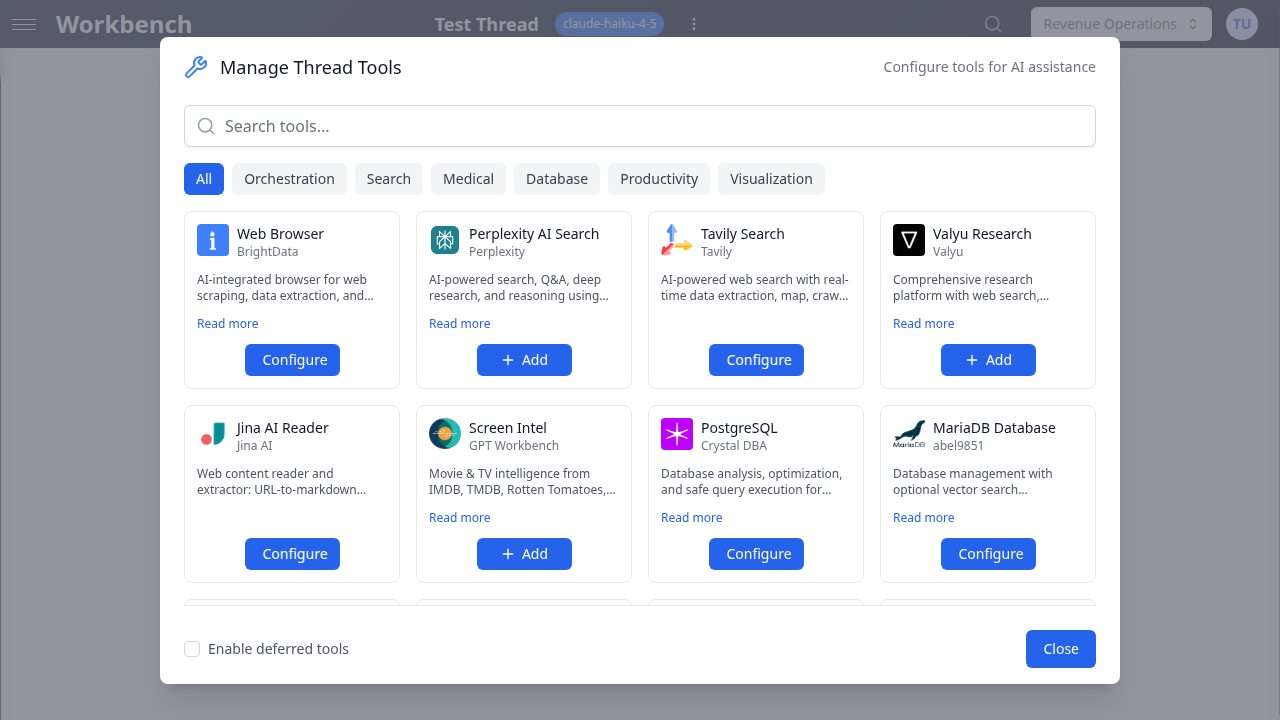
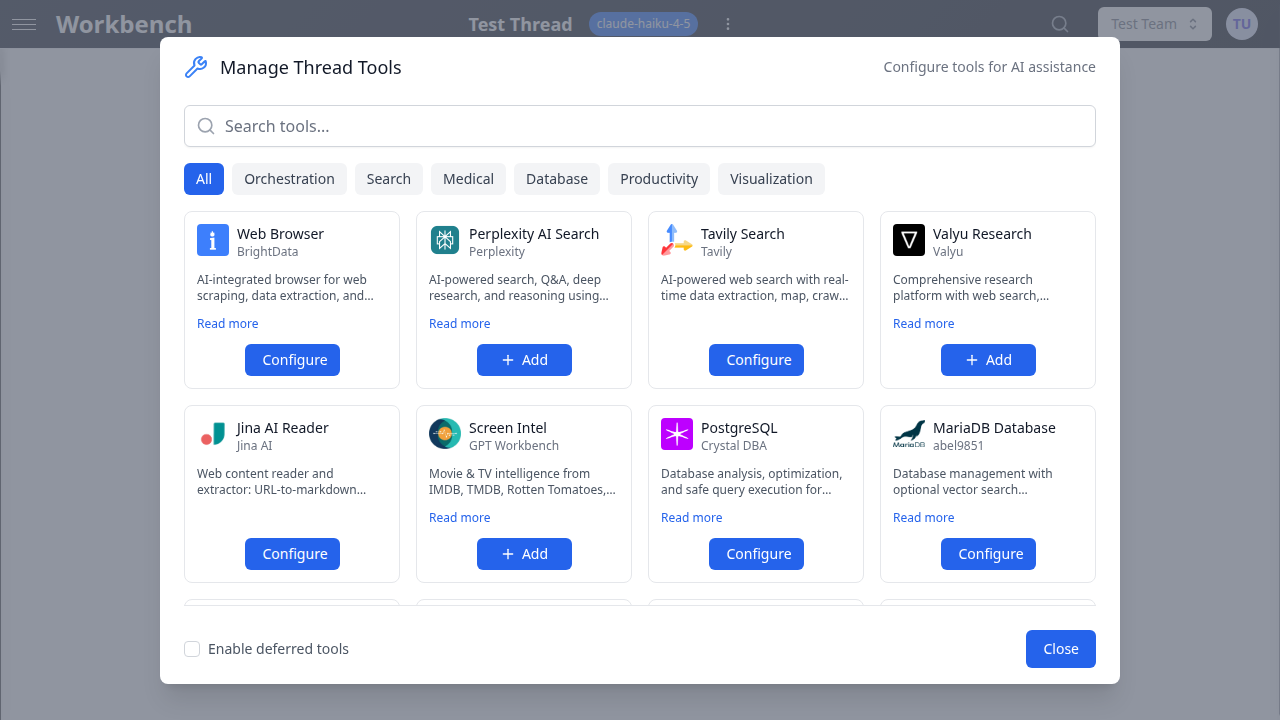
Healthcare tools are enabled the same way as any other tool in GPT Workbench:
- Open the thread where you want to use healthcare tools.
- Click the Tools button in the toolbar.
- Scroll to the Medical category or use the search field.
- Toggle the specific tools you need.
For tools that require configuration (DrugBank, REDCap, Zotero), fill in the required API keys or credentials in the tool's settings panel.
Organization administrators can pre-configure API keys so that all team members have access without managing individual credentials.
Genomics and Genetics
Six tools for analyzing genetic variants, protein structures, and population-level genomic data.
AlphaFold Protein Structure
- Tool name: alphafold-mcp
- Provider: EMBL-EBI
- Description: Query the AlphaFold v2 Protein Structure Database. Retrieve pre-computed 3D protein structures by UniProt ID, analyze prediction confidence, batch process proteins, compare structures, and export for PyMOL or ChimeraX visualization.
- Configuration: No API key required.
Key use cases:
- Retrieve predicted 3D structures for a protein by UniProt accession
- Assess prediction confidence (pLDDT scores) for structural regions
- Batch process multiple proteins for comparative structural analysis
- Export structure data for downstream visualization tools
Example queries:
- "Show me the AlphaFold structure for human p53 (UniProt P04637)"
- "Compare AlphaFold confidence scores for BRCA1 and BRCA2"
AlphaGenome
- Tool name: alphagenome-mcp
- Provider: Google DeepMind
- Description: AI-powered genomic sequence analysis. Predict DNA regulatory features, assess variant pathogenicity, and analyze chromosomal intervals with single base-pair resolution using Google DeepMind's AlphaGenome API.
- Configuration: No API key required. Requires numpy, pandas, and alphagenome Python packages (installed automatically).
Key use cases:
- Predict regulatory effects of non-coding variants
- Assess variant pathogenicity at base-pair resolution
- Analyze DNA regulatory features across chromosomal intervals
Example queries:
- "Predict the regulatory impact of rs12345 using AlphaGenome"
- "Analyze the chr17:41196312-41277500 interval for regulatory features"
gnomAD Genetic Database
- Tool name: gnomad-mcp
- Provider: Broad Institute
- Description: Query genetic variants, gene constraints, and population genetics data from the Genome Aggregation Database (gnomAD). Essential for clinical genetics, rare disease diagnosis, and drug discovery research.
- Configuration: No API key required.
Key use cases:
- Look up allele frequencies for a specific variant across populations
- Check gene constraint metrics (pLI, LOEUF) to assess loss-of-function intolerance
- Determine whether a variant is common or rare in specific populations
- Support variant classification for clinical genetics workflows
Example queries:
- "What is the allele frequency of rs1801133 in gnomAD?"
- "Show me the constraint metrics for the CFTR gene"
- "Is the variant 13-32936646-C-T rare in European populations?"
Ensembl VEP
- Tool name: vep-mcp
- Provider: Ensembl
- Description: Annotate and predict effects of genetic variants using Ensembl VEP. Supports HGVS notation, rsIDs, and genomic regions with pathogenicity scores (AlphaMissense, CADD, REVEL), conservation metrics, and functional annotations.
- Configuration: No API key required.
Key use cases:
- Annotate variants with predicted functional consequences
- Retrieve pathogenicity predictions from multiple scoring algorithms
- Determine transcript-level effects (missense, nonsense, splice-site)
- Combine with gnomAD frequency data for variant interpretation
Example queries:
- "What is the predicted effect of BRAF V600E using VEP?"
- "Annotate these variants: rs121913529, rs28897696"
- "Get CADD and AlphaMissense scores for NM_004333.6:c.1799T>A"
PGS Catalog
- Tool name: pgscatalog-mcp
- Provider: EMBL-EBI / University of Cambridge
- Description: Search polygenic scores, publications, traits, and performance metrics from the PGS Catalog. Essential for polygenic risk score research, genetic epidemiology, and precision medicine.
- Configuration: No API key required.
Key use cases:
- Find published polygenic scores for specific diseases or traits
- Retrieve performance metrics and validation data for a PGS
- Identify studies contributing to polygenic score development
- Compare multiple scores for the same trait
Example queries:
- "Find polygenic scores for type 2 diabetes in the PGS Catalog"
- "What are the performance metrics for PGS000013?"
- "List all PGS publications related to coronary artery disease"
GWAS Catalog
- Tool name: gwas-catalog-mcp
- Provider: NHGRI-EBI
- Description: Find published genetic associations between DNA variants and diseases or traits from the NHGRI-EBI GWAS Catalog, covering approximately 6,700 studies and 575,000 associations. Query by variant rsID, disease or trait name, study accession, or genomic region. Distinct from gnomAD (population frequencies) and OpenTargets (drug targets).
- Configuration: No API key required.
Key use cases:
- Find all GWAS-significant variants associated with a disease
- Look up which traits are associated with a specific variant
- Retrieve study details and effect sizes for genetic associations
- Explore associations within a genomic region
Example queries:
- "What variants are associated with Alzheimer's disease in the GWAS Catalog?"
- "Which traits are associated with rs429358?"
- "Show GWAS studies for the APOE locus on chromosome 19"
Pharmacology and Drug Information
Four tools for drug databases, pharmacogenomics guidelines, and chemical compound information.
DrugBank Database
- Tool name: drugbank-mcp
- Provider: DrugBank
- Description: Comprehensive drug database with interactions, indications, and detailed pharmaceutical information. Search drugs, find treatments for conditions, and check drug interactions.
- Configuration: Requires a DrugBank API key (obtain from dev.drugbank.com). Optional: configure maximum results per query.
Key use cases:
- Search for drugs by name and retrieve pharmacological profiles
- Check drug-drug interactions before prescribing
- Find approved treatments for a specific condition
- Access pharmacokinetic and pharmacodynamic data
Example queries:
- "Find all known interactions for warfarin"
- "What drugs are approved for treatment-resistant depression?"
- "Show me the pharmacological profile of metformin"
CPIC Research
- Tool name: cpic-mcp
- Provider: CPIC
- Description: Search and access the Clinical Pharmacogenomics Implementation Consortium (CPIC) API. Retrieve guidelines for drug-gene pairs, dosing recommendations based on genotype, and pharmacogenomic evidence levels.
- Configuration: No API key required.
Key use cases:
- Look up CPIC dosing guidelines for a specific drug-gene pair
- Determine the recommended action for a patient's genotype
- Find all drugs with pharmacogenomic guidelines
- Check the evidence level for a gene-drug interaction
Example queries:
- "What does CPIC recommend for CYP2D6 poor metabolizers taking codeine?"
- "List all CPIC guidelines for the CYP2C19 gene"
- "Is there a CPIC guideline for tamoxifen and CYP2D6?"
PubChem
- Tool name: pubchem-mcp
- Provider: NIH / NLM
- Description: Access the PubChem chemical database for compound search, structure analysis, molecular properties, bioassay data, and safety information. No API key required.
- Configuration: No configuration required.
Key use cases:
- Search for chemical compounds by name, formula, or structure
- Retrieve molecular properties (weight, LogP, polar surface area)
- Access bioassay results and biological activity data
- Look up safety data sheets and hazard information
Example queries:
- "Find the molecular properties of aspirin in PubChem"
- "What bioassays have tested ibuprofen?"
- "Show the chemical structure and SMILES for caffeine"
BDPM - French Drug Database
- Tool name: bdpm-mcp
- Provider: ANSM
- Description: French public drug database with approximately 15,000 medications, their compositions, pricing, and generic alternatives. Based on official ANSM data (Base de Donnees Publique des Medicaments).
- Configuration: No API key required.
Key use cases:
- Search for medications available in France by name or active ingredient
- Look up drug compositions, dosages, and administration routes
- Find generic alternatives and pricing information
- Check marketing authorization status and conditions
Example queries:
- "Find all medications containing amoxicilline in the BDPM"
- "What generic alternatives exist for Doliprane 1000mg?"
- "Show the composition and pricing for Augmentin"
Clinical Research
Three tools for clinical trial search, research data capture, and family pedigree generation.
ClinicalTrials.gov
- Tool name: clinicaltrials-mcp
- Provider: NIH
- Description: Access the ClinicalTrials.gov database for searching clinical studies, retrieving trial details, and analyzing clinical research trends. Compliant with NIH API guidelines.
- Configuration: No API key required.
Key use cases:
- Search for active clinical trials by condition, intervention, or location
- Filter trials by phase, status, and enrollment criteria
- Retrieve detailed protocol information and eligibility criteria
- Track clinical research trends for a therapeutic area
Example queries:
- "Find Phase 3 clinical trials for NSCLC immunotherapy recruiting in France"
- "What clinical trials are studying CRISPR for sickle cell disease?"
- "Show recruiting trials for Alzheimer's disease with results posted"
REDCap Research
- Tool name: redcap-mcp
- Provider: Vanderbilt University
- Description: Search and access REDCap (Research Electronic Data Capture) API. Query research project data, manage records, and upload files to REDCap instances.
- Configuration: Requires REDCap API base URL and at least one project token. Supports multiple project configurations.
Key use cases:
- Query patient records from REDCap research projects
- Export data for analysis from configured projects
- Upload files to specific record fields
- Manage multi-project research data access
Example queries:
- "List all records in the REDCap project"
- "Export data from the demographics form"
- "Upload this document to patient record 101, field consent_form"
Pedigree Generator
- Tool name: pedigree-mcp
- Provider: Workbench
- Description: Generate family pedigree tree diagrams as PNG images. Includes comprehensive documentation for the required data format. The AI calls the documentation function first to understand the required data structure, then generates the pedigree from patient data.
- Configuration: No API key required.
Key use cases:
- Generate standard medical pedigree charts from family history data
- Visualize inheritance patterns for genetic conditions
- Create publication-ready family tree diagrams
- Document multi-generational disease patterns
Example queries:
- "Create a pedigree for a family with autosomal dominant breast cancer"
- "Generate a three-generation family tree showing carriers of cystic fibrosis"
Biomedical Literature
Six tools for searching, retrieving, and managing biomedical publications.
PubMed Research
- Tool name: pubmed-mcp
- Provider: NIH / NLM
- Description: Advanced PubMed search with article connections, research planning, and data visualization. Search, retrieve, and analyze biomedical literature from the PubMed database.
- Configuration: No API key required.
Key use cases:
- Search for peer-reviewed articles by topic, author, or MeSH terms
- Retrieve abstracts and citation metadata
- Explore article connections and related publications
- Plan literature review strategies
Example queries:
- "Search PubMed for meta-analyses on statin therapy and cardiovascular outcomes published in 2024"
- "Find articles by Jennifer Doudna on CRISPR"
- "Show me recent reviews on gut microbiome and mental health"
PubTator3
- Tool name: pubtator-mcp
- Provider: NIH / NLM
- Description: Biomedical literature annotation and relationship mining. Export annotations, find entity IDs, discover relationships, and search the PubTator3 database for scientific literature analysis.
- Configuration: No API key required.
Key use cases:
- Extract named entities (genes, diseases, chemicals) from biomedical text
- Discover relationships between biomedical entities across publications
- Export structured annotations from articles
- Find entity identifiers for standardized reference
Example queries:
- "Find all gene-disease relationships mentioned in PMID 35238950"
- "Extract chemical entities from recent articles on COVID-19 treatments"
- "What genes are associated with Parkinson's disease in PubTator?"
PubMatcher Genomics
- Tool name: pubmatcher-mcp
- Provider: Workbench
- Description: Multi-database genomic analysis covering HGNC gene validation, PubMed literature, ClinVar variants, gnomAD constraints, UniProt function, IMPC mouse phenotypes, PanelApp panels, and OMIM diseases.
- Configuration: No API key required.
Key use cases:
- Validate gene symbols against HGNC nomenclature
- Cross-reference genomic data across multiple authoritative databases
- Retrieve gene function, variant pathogenicity, and phenotype data in a single query
- Build comprehensive gene profiles for clinical interpretation
Example queries:
- "Get a full genomic profile for the TP53 gene using PubMatcher"
- "Cross-reference BRCA2 across ClinVar, gnomAD, and OMIM"
- "Validate the gene symbol MLH1 and retrieve associated panels from PanelApp"
bioRxiv Research
- Tool name: biorxiv-mcp
- Provider: Cold Spring Harbor Laboratory
- Description: Search and access bioRxiv preprint papers. Enables research discovery with keyword searches, metadata retrieval, and paper downloads for biological sciences research.
- Configuration: No API key required.
Key use cases:
- Search for the latest preprints in a specific field before peer review
- Access full preprint text and metadata
- Track emerging research trends in biological sciences
- Find preprints from specific research groups
Example queries:
- "Search bioRxiv for recent preprints on single-cell RNA sequencing"
- "Find preprints about CRISPR base editing published this month"
medRxiv Research
- Tool name: medrxiv-mcp
- Provider: Cold Spring Harbor Laboratory / BMJ
- Description: Search and access medRxiv medical preprint papers. Enables medical research discovery with keyword searches, metadata retrieval, and paper downloads for health sciences research.
- Configuration: No API key required.
Key use cases:
- Search for medical preprints before peer-reviewed publication
- Access the latest clinical and epidemiological research
- Track emerging findings in public health and clinical medicine
- Compare preprint findings with published literature
Example queries:
- "Search medRxiv for preprints on long COVID neurological effects"
- "Find recent medRxiv preprints on mRNA vaccine durability"
Zotero Research Library
- Tool name: zotero-mcp
- Provider: Zotero
- Description: Connect to your Zotero research library for semantic search, paper summaries, metadata retrieval, citation analysis, and annotation management. Cloud-based access via the Zotero Web API.
- Configuration: Requires Zotero API key, library ID, and library type (user or group).
Key use cases:
- Search your personal or group Zotero library semantically
- Retrieve citation metadata and annotations
- Manage references from within a conversation
- Export citations in standard formats
Example queries:
- "Search my Zotero library for papers on pharmacogenomics"
- "List recent additions to my Zotero library with their tags"
- "Find all annotated papers in my genomics collection"
Bioinformatics and Data
Three tools for cross-database biomedical queries and drug target identification.
BioThings Research
- Tool name: biothings-mcp
- Provider: BioThings / Scripps Research
- Description: Access biomedical data from mygene.info, myvariant.info, and mychem.info. Query gene annotations, variant data, chemical compounds, and taxonomic information for research and clinical applications.
- Configuration: No API key required.
Key use cases:
- Query gene annotations from mygene.info
- Retrieve variant data from myvariant.info
- Access chemical compound information from mychem.info
- Perform batch queries across multiple biomedical data types
Example queries:
- "Query mygene.info for annotations on the EGFR gene"
- "Look up variant chr7:g.140453136A>T in myvariant.info"
- "Find chemical information about imatinib in mychem.info"
OpenTargets Platform
- Tool name: opentargets-mcp
- Provider: EMBL-EBI / Wellcome Sanger
- Description: Explore gene-drug-disease relationships using data from ChEMBL, Ensembl, UniProt, and 22+ databases. Features target analysis, disease analysis, drug discovery, evidence mining, variant analysis, and smart search capabilities.
- Configuration: No API key required.
Key use cases:
- Identify druggable targets for a specific disease
- Explore evidence linking a gene to a disease
- Find drugs in development for a therapeutic target
- Analyze the druggability and tractability of a gene
Example queries:
- "What drugs target the BRAF gene according to OpenTargets?"
- "Show evidence linking JAK2 to myeloproliferative neoplasms"
- "Find all known drug targets for rheumatoid arthritis"
BioContext Knowledgebase
- Tool name: biocontext-mcp
- Provider: Workbench
- Description: Unified access to 20+ biomedical databases including STRING, KEGG, Reactome, OpenTargets, UniProt, Ensembl, ClinicalTrials, EuropePMC, and more.
- Configuration: No API key required.
Key use cases:
- Query multiple biomedical databases through a single interface
- Find protein-protein interactions (STRING)
- Explore metabolic and signaling pathways (KEGG, Reactome)
- Cross-reference entities across databases
Example queries:
- "Find protein interactions for TP53 in STRING via BioContext"
- "Show KEGG pathways involving the mTOR signaling cascade"
- "Retrieve Reactome pathways for autophagy-related genes"
Nutrition and Food Safety
ANSES Ciqual Database
- Tool name: ciqual-mcp
- Provider: ANSES
- Description: French food composition database with nutritional data for thousands of foods. Query using SQL with fuzzy search support for comprehensive nutritional analysis.
- Configuration: No API key required.
Key use cases:
- Look up detailed nutritional composition for specific foods
- Compare nutrient content across food groups
- Support dietary planning with precise macronutrient and micronutrient data
- Perform nutritional analysis for research or clinical purposes
Example queries:
- "What is the nutritional composition of raw chicken breast in the Ciqual database?"
- "Compare the iron content of lentils, spinach, and red meat"
- "Find foods with the highest vitamin D content"
Common Workflows
Healthcare tools are most effective when combined. The following workflows illustrate how multiple tools complement each other for common research tasks.
Drug-Gene Interaction Analysis
Determine how a patient's genetics may affect drug response:
- CPIC -- Look up pharmacogenomic guidelines for the drug-gene pair.
- DrugBank -- Retrieve the full pharmacological profile and known interactions.
- gnomAD -- Check the population frequency of relevant genetic variants.
- OpenTargets -- Explore the broader evidence linking the gene to drug response.
Systematic Literature Review
Conduct a comprehensive literature search across multiple sources:
- PubMed -- Search for peer-reviewed articles on the topic.
- bioRxiv / medRxiv -- Find relevant preprints not yet peer-reviewed.
- PubTator -- Extract named entities and relationships from key articles.
- Zotero -- Save and organize references in your library.
Variant Interpretation
Classify and interpret a genetic variant for clinical purposes:
- VEP -- Annotate the variant with predicted functional consequences and pathogenicity scores.
- gnomAD -- Determine the variant's population frequency.
- GWAS Catalog -- Check whether the variant has known disease associations.
- OpenTargets -- Explore whether the affected gene is a drug target.
- PubMed -- Search for published functional studies on the variant.
Clinical Trial Discovery
Find relevant clinical trials for a specific condition:
- ClinicalTrials.gov -- Search for active trials by condition, phase, and location.
- PubMed -- Retrieve published results from completed trials.
- DrugBank -- Look up the investigational drugs being tested.
- bioRxiv / medRxiv -- Find preprints with preliminary trial data.
Protein Structure Analysis
Investigate a protein's structure and related genetic data:
- AlphaFold -- Retrieve the predicted 3D structure.
- VEP -- Annotate known variants in the protein-coding gene.
- BioThings -- Query gene annotations and functional data.
- PubMed -- Search for structural biology publications.
Best Practices
Start broad, then narrow. Use PubMed or BioContext for initial exploration, then switch to specialized tools (gnomAD, CPIC, DrugBank) for detailed data.
Cross-reference across databases. No single database is comprehensive. Verify findings by querying the same entity in multiple tools. For example, check a variant in both gnomAD (frequency) and VEP (functional impact).
Use standard identifiers. Tools work best with standard identifiers: rsIDs for variants (rs1801133), UniProt accessions for proteins (P04637), HGNC symbols for genes (TP53), and PubMed IDs for articles (PMID 35238950).
Enable only the tools you need. Enabling all 23 healthcare tools at once increases prompt complexity. Select the tools relevant to your current task.
Combine with general tools. Healthcare tools work well alongside general MCP tools. Use Perplexity for web context, AntV Charts for data visualization, or the Calculator for statistical computations.
Verify clinical information. These tools provide research data, not clinical advice. Always verify findings against authoritative clinical guidelines and consult qualified healthcare professionals for patient care decisions.